Downtown (Part III) – Angels Flight

angels-flight-blog_6921.jpg

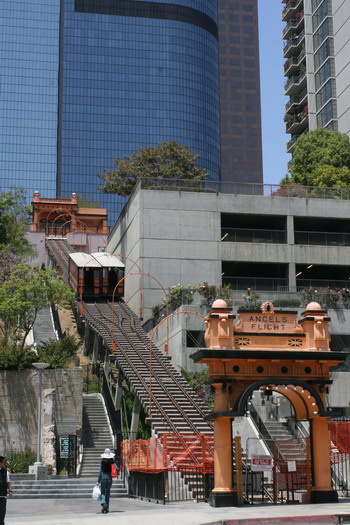
At the turn of the century (19th to 20th, that is) Bunker Hill in Downtown was what the English would call a “posh” area. It was not only a desirable living quarter, it also loomed above the lower parts of Downtown. The incline was (and is) short, but steep, which made people grumble just enough to let others see an entrepreneurial opportunity – and the Angels Flight was born.

Two cars, named Olivet and Sinai, transported people up and down Bunker Hill and saved them the terrible task of walking up the hill. Even when Downtown deteriorated, Angels Flight still ran and ran, beloved not only by those living there, but also by film makers. Amongst others these films have scenes where the funicular plays a part:

All Jazzed Up (1920)
The Impatient Maiden (1932)
The Unfaithful (1947)
Criss Cross (1948)
Hollow Triumph/The Scar (1948)
The Night Has A Thousand Eyes (1948)
Act Of Violence (1949)
Once A Thief (1950)
Southside 1-1000 (1950)
The Turning Point (1952)
The Glenn Miller Story (1953)
Cry Of The Hunted (1953)
Kiss Me Deadly (1955)
The Indestructible Man ( 1956)
The Exiles (1961)
Perry Mason “The Case Of The Twice-Told Twist” (1966)
The Money Trap (1966)
City of Angels (1998)

Then Angels Flight was dismantled in 1969. With the beginning of redevelopment of Bunker Hill from a run-down eye-sore to what it is today, it had to go. Fortunately it was not totally scrapped, but placed into storage; there it sat for 27 years, to be rebuilt and reopened half a block away from its original site in 1996. In October 2000 Angels Flight was added to the National Register of Historic Places.

In February 2001 a serious accident happened – Sinai when approaching the upper terminus reversed and collided with Olivet coming up the hill. One passenger was killed, several others were injured and Angels Flight was put out of commission again.

After lengthy investigations into the cause of the accident and an overhaul of the system the cars are back on the tracks again since the end of 2008. However, Angels Flight has not started to operate yet; hopefully, it will run again some time this year.

And nobody has ever corrected the strange spelling. But then, how can one – after all, it is a historic landmark, spelling mistakes and all.
Downtown (Part II) – Adaptive Re-Use

The former “Real” Downtown, today known as the Historic Core, starts at Hill street and stretches to the South. What was once (before WW II) the center of the city with company headquarters, banks, department stores, theaters, cinemas, apartment buildings, restaurants and bars, started to change in the ’50s. People packed up and moved to the suburbs, because life out there was cheaper, with more room for the kids in the backyard. The financial institutions all moved across Hill Street. Even though that was just a few blocks away, the impact was massive. Company headquarters too, moved to pastures new and cheaper in the outlying areas. The department stores, already on a shaky footing, lost more customers, because those now shopped in the suburbs.  Theaters and cinemas, likewise losing their clientèle,  changed their programs to entertainment not quite on the same level as during their heydays, they became grind houses . More people left to live in paradise (aka “the ‘burbs”) and the demographics changed – Latinos started to move downtown, taking over the emptying apartment buildings, the theaters and the cinemas, turning Downtown into the hopping center of  Latino entertainment. Which prompted the last few Anglos to flee.

The downward spiral moved faster and faster. Buildings started to crumble. Prostitution, drug dealing, street gangs became a huge problem. The Homeless lived on the streets. All this more or less killed all traditional commercial activities, which again drove everybody away who could afford it. The riots of 1992  spread all over the city; one of the centers of unrest was Parker Center, the LAPD headquarters downtown. The Northridge Earthquake of 1994 started another wave of flight from the city. By 1999 the official number of people still living in Downtown was 18,000, most of them Latinos and low-income. But those by then had created their own environment, with small shops and stores, very lively and bustling with people who called the area their home.

At that point City Hall moved. It created the Adaptive Re-Use Ordinance, which was again overhauled in 2003 and which started a complete change in the Historic Core by, basically, giving the area over to market forces, while hoping for the best.

The gamble paid off – in part, for some at least.

One has to explain what the Adaptive Re-Use Ordinance is: it is a carte blanche for developers to convert any existing structures in the Historic Core into living quarters and commercial space. Which is exactly what happened – suddenly more and more and more of the crumbling buildings were and are being restored to their former glory outside, and into fabulous apartments and lofts inside. Part of the Ordinance was that a certain percentage of the newly created living spaces were supposed to be affordable for low-income families.

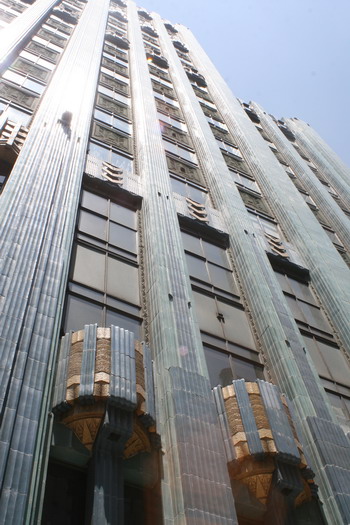
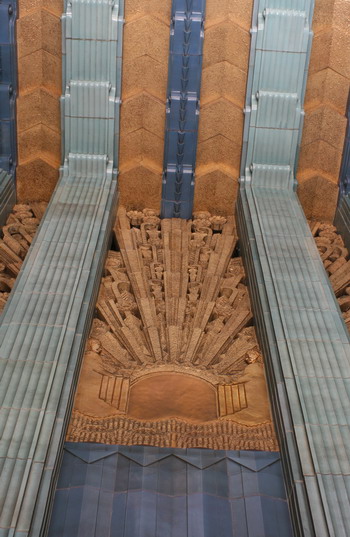
An example – and one of the best ones – is the Eastern Columbia Building, a former clothing and furniture store built in 1930.

eastern-columbis-blog_6884.jpg

It has been restored impeccably with spectacular apartments inside and a roof garden with pool. The design above the front doors alone is breathtakingly beautiful.

eastern-columbis-2-blog_6890.jpg

Low-income renters however will hardly ever pass through those doors, says the cynic in me. Rumor has it that the provisions in the Ordinance governing this part can be handled quite “creatively.”

And there you have it – the Historic core is changing again. A new cycle is beginning, with those people formerly too poor to live in better areas being driven out yet again because they can not afford to stay downtown.

Which leaves me with the question – where will they go now?

Downtown (Part I) – Pershing Square

The layout of  Downtown Los Angeles needs a word of explanation: the area is basically split into two – the “old” and the “new” one. The new part is the one with the banks, the museums, the courts, the Civic Center; it is polished and quite impressive. It is also quite empty after 8 PM and on weekends, apart from the visitors to the museums and the Disney Concert Hall.

The city tried for years to re-enliven this side of Downtown. Sure, people live there; the apartments in the high-rises downtown are very nice and very modern, as they should be, being quite, quite expensive. But until two years ago there was not one single supermarket in the area. Not one! Then a Ralph’s moved in, a fact so spectacular that it was even mentioned in the local newspapers. So one gets the idea – this side of Downtown is more for the affluent, sans kids.

The divide between the “new” and the “old” is Hill Street, where one also finds Pershing Square. One can see the difference when one stands on a Saturday or Sunday on the corner of Hill and 5th Street (with Pershing Square to the left). Looking left – empty streets; looking right – teeming life.

What is happening down there will be shown later. Today – Pershing Square.

This park, covering exactly one square block, has changed names so often since the middle of the 19th century that one loses count. Finally, in 1918, the city named it in honor of General Pershing. When Downtown declined during the ‘50s due to the move out to the suburbs, the park followed suit and became such an eyesore that by 1984 – in time for the Summer Olympics – the city finally coughed up $1 million to fix the place at least temporarily.

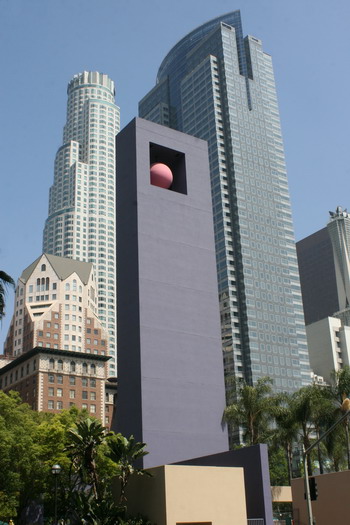
Then, at the beginning of the ‘90s, the movement to re-enliven Downtown began. In 1992 Pershing Square was closed down and over the next two years the Mexican architect Ricardo Legorreta and landscape architect Laurie Olin gave the park a complete overhaul. This time the budget was over $14 million. The idea behind the renovation was to celebrate the roots of Los Angeles (which are Hispanic, as is well known); therefore Legorreta and Olin came up with a very, very modern take on a Spanish plaza. There are trees, there is water, there is art, places to rest, a concert stage plus a seasonal skating-rink; and as no decent Spanish plaza is without a church and a tower, there is also a tower. A purple one. Ten stories high.

pershing-square_blog_6856.jpg

The orange ball at the top of the tower is not a sign that this quite striking monument was sponsored by a certain bank. These orange balls are popping up at other places in Pershing Square. Why? How should I know? I assume that they were put there just to make people smile. Which certainly works for me.